
Relationship Essentials
Introduction
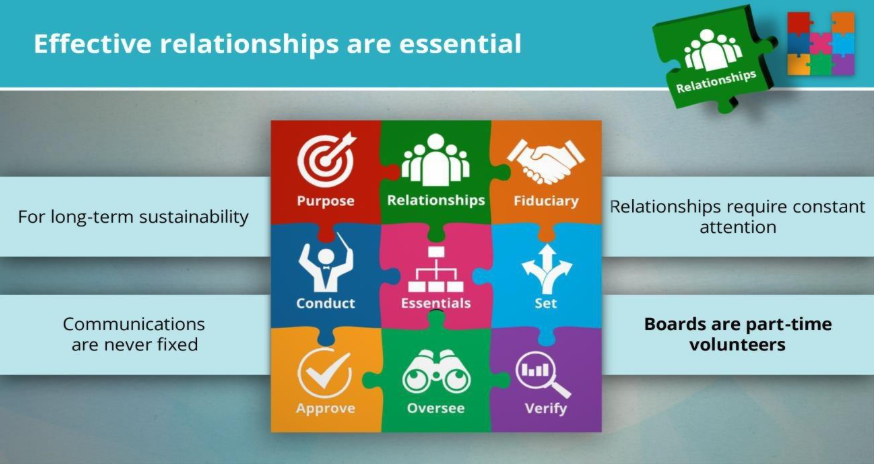
Relationships are essential in the governance of public retirement systems. They are critical puzzle pieces in governance, essential to creating, delivering, and protecting value for all members and beneficiaries.
Good Governance Begins with Purpose
The purpose of a public retirement system is to sustainably create, deliver, and protect value for current and future members. This is achieved through strong relationships and constructive communication.
The board fulfills its fiduciary duties through five key powers:
Conducting the business of the board.
Setting direction and policy.
Approving key decisions and delegating.
Overseeing execution within policy and providing advice.
Verifying the reliability of information and advice.
Effective governance depends on well-maintained relationships with clear roles and accountabilities. Communication requires constant attention and adjustment.
Trustees’ Role Trustees are part-time volunteers, meeting about four to six times a year for a few hours. As non-experts with limited time, they hire professional staff, led by the chief executive, to manage operations.
Critical questions the board should ask about relationships:
What are the essential external, internal, and independent relationships?
Why are they important?
How can they be strengthened in a fast-changing environment?
Managing Change: Retirement systems face rapid change. The National Association of State Retirement Administrators (NASRA) highlighted unprecedented changes to pension plans in 2018, a trend that continues today. Boards must manage change prudently, ensuring stakeholders are informed and consulted on decisions that impact them.
What are the essential relationships and lines of communication?
The board’s relationships and communications fall into three essential lines:
External: Engaging members, beneficiaries, legislators, and the public.
Internal: Managing the relationship between the board and the chief executive and staff.
Independent: Collaborating with independent advisors and auditors.
External Relationships
The board holds responsibility for building relationships with external stakeholders before issues arise. Key external stakeholders include:
Members and beneficiaries: Trustees owe them a duty of loyalty to ensure the system’s sustainability.
Legislators and overseers: They have the power to change rules affecting the system.
Public employers and sponsors: Their contributions are critical to pension soundness.
The general public: They elect governments and provide the tax base for pensions.
Understanding stakeholder perspectives is crucial for making informed decisions and demonstrating prudence. The chief executive (CE) is typically responsible for engaging external stakeholders.
Internal Relationships
The board, akin to the boat owners in an organization, is not part of the operational "crew." It sets direction, policy, and key decisions, delegating authority to the CE responsible for executing operations. The relationship between the board and the CE is vital. The CE, as the “chief everything officer,” manages the organization's staff and operations while providing strategic advice to the board.
The 1st Line consists of officers and staff handling core retirement functions like investments and benefits. They report to the CE but maintain a dotted-line relationship with the board. This structure ensures clear accountability while giving the board access to operational insights.
The 2nd Line includes functions like HR, risk, compliance, legal, and IT. These roles support the primary retirement functions and help identify and address exceptions while providing reasonable assurance to the board.
Independent Relationships
Independent relationships outside the chain of command are essential for boards to verify management’s assurances. The most significant risks arise when the board assumes things are under control when they aren’t. Independent relationships with internal and external auditors provide the verification needed to avoid being blindsided.
Verification Through Independence The board must verify and trust through independent relationships. Internal audit (the 3rd Line) provides independent verification of management’s reports, ensuring controls are effective and the organization adheres to policy. Internal auditors report directly to the board, not the CE.
The 4th Line includes external auditors and independent advisors such as actuaries, fiduciary counsel, and investment consultants. They verify through specialized expertise and offer a second opinion, which may create productive tension with management. These relationships are also a source of continuing education for the board.
Tying It All Together
An organization is like fabric—its strength comes from how well its relationships are woven together. These relationships, spanning the 1st, 2nd, 3rd, and 4th lines, require regular maintenance and attention to ensure effectiveness and avoid gaps. The board must oversee a balance in these relationships, always ensuring they are focused on creating and protecting value.
Lessons Learned
Effective governance requires maintaining strong, clear, and purpose-driven relationships. The board must constantly ask critical questions, adapt to change, and engage stakeholders to ensure informed decision-making and demonstrate prudence.
Through continuous verification and relationship management, the board fulfills its role in protecting the long-term sustainability of the retirement system.